Room: Technology News Android
JackpotCity Online
Technology News ANDROID 5
The temperature of Earth’s surface is generally pretty stable, but it has to let heat off somehow. When heat waves rise off a sidewalk, for example, they dissipate into cooler air. That cooling process eventually reaches the upper atmosphere and then the cold, lifeless environs of space, in a process called radiative sky cooling. Scientists want to use the principles behind radiative sky cooling to create a low-cost energy source that could help people all over the world who lack stable electricity.
“This effect occurs naturally all the time, especially on clear nights,” says study author Aaswath Raman, an assistant professor of materials science and engineering at the UCLA Samueli School of Engineering, in a press statement. “The result is that the object ejecting the heat, whether it’s a car, the ground or a building, will be slightly cooler than the ambient temperature.”
Radiative sky cooling occurs wherever there’s a ground and a sky. A surface facing the sky will eventually eject some of its heat, and that rejection takes the form of thermal radiation.
The air of Earth’s atmosphere doesn’t have as stable a temperature as the ground. The UCLA team’s technology uses those temperatures differences to their advantage. It captures some of the heat from the surrounding air that would otherwise rise into the sky. That heat is then converted it into electricity.
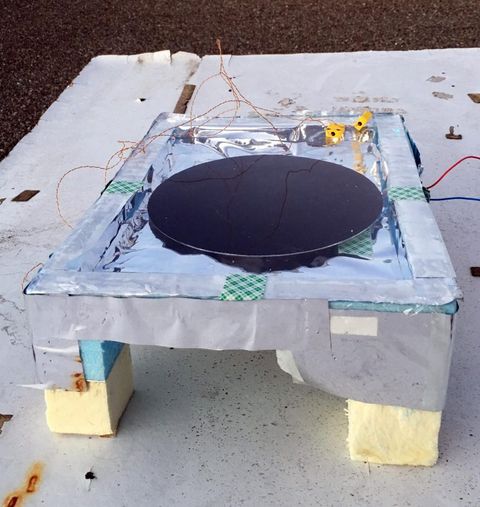
To prove that their technology could provide renewable electricity at a low cost, the researchers built a proof-of-concept device using parts purchased at hardware and electronic supply stores. The total cost? Under $30.
Testing the system, the scientists used a rooftop in Stanford, California, in late December 2017 under clear-sky conditions. It was in the evening and it was cold, with temperatures hovering between -1 and -3 degrees Celsius during testing. Then, they brought out an aluminum disk painted black on one side, which faced the sky.
The team then used the black disk to radiate the heat being given off by the surrounding air. A thermoelectric generator, which produces electric voltage in response to a temperature difference, converted the heat into electricity.
The end result? The team generated 25 milliwatts per square meter, which could power a single LED light bulb. That’s less than a single solar cell, but the two need not work in opposition.
Technology News ANDROID 4
Scientists are analysing the images taken under harsh light conditions by the NASA Lunar Reconnaissance Orbiter (LRO) Camera of the area where the Vikram moon lander is likely to have touched down on the moon and it may be a while before they can locate it, project experts told IANS.
LRO project scientist at NASA’s Goddard Space Flight Center, Noah Petro, said on Wednesday that they were now analysing the images taken on Tuesday “and we will make a statement at some point when we can identify the lander.”
But he added, “It is important to remember that the illumination conditions right now where the lander may be are harsh.”
Therefore, it “could be difficult to identify right now (and it) may be a little longer before we have another opportunity to image the landing site next October 14” when the LRO next passes over that area of the moon.
The principal investigator for the LRO camera, Mark Robinson of Arizona State University, said that the last image of the area was acquired on Wednesday and will take time to analyse as there are “lots and lots and lots of pixels” to go through.

A NASA statement carried a note of caution saying that when the LRO flew over the Vikram landing site near dusk, with large shadows covering the area.”
The LROC “acquired images around the targeted landing site, but the exact location of the lander was not known so the lander may not be in the camera field of view,” NASA said.
“The LROC team will analyze these new images and compare them to previous images to see if the lander is visible (it may be in shadow or outside the imaged area),” it added.
Vikram lost contact with the Indian Space Research Organisation after it was launched by the Chandrayaan-2 moon orbiter to touch down in the area of the moon’s south pole on September 6.
After following the intended trajectory, it deviated in the final moments during the last two kilometres of the descent and went silent.
Vikram carried a rover called Pragyan that was to have conducted experiments on the moon’s surface.
Aviation Week created some confusion on Wednesday with an erroneous headline, “NASA’s LRO fails to spot Chandrayaan-2 Lander,” which was picked up by others.
Both the scientists IANS spoke to said the headline was wrong.
Robinson said: “They are rather astonishing because we haven’t had the images to look at yet. I don’t know where that came from.”
Petro said, “The headline is wrong. That was actually posted even before we had the data on the ground.”
The publication later changed the headline to “NASA’s LRO Begins Search For Silent Chandrayaan-2 Lander.”
Technology News ANDROID 3
/cdn.vox-cdn.com/uploads/chorus_image/image/65277790/srihK7j.0.jpg)
After a week that saw renders, photographs, and even a couple of hands-on video reveals much about Huawei’s latest flagship phones ahead of their announcement, the Mate 30 series is now official, starting with the Mate 30 Pro and the Mate 30.
Both phones have a Leica-branded rear camera array contained within a circular camera cutout that Huawei is calling a “Halo ring design.” However, the Mate 30 Pro has a 6.53-inch screen which curves around the edges of the device, while the regular Mate 30 has a more traditional flat display that’s slightly bigger at 6.62-inches in size. Battery sizes also differ between the two phones; the Mate 30 Pro has a larger 4,500mAh battery, compared to 4,200mAh in the Mate 30.
Since the Mate 30 Pro’s display curves around the edges of the device, Huawei has ditched the physical volume buttons on the side of the device, in favor of a new touch-sensitive solution. It’s a similar technology to what we’ve seen on Vivo’s Nex 3.
The Mate 30 Pro is available in six colors in total, including two vegan leather options; green and orange. Other colors include silver, green, purple, and black.
Internally, the Mate 30 and Mate 30 Pro phones use Huawei’s Kirin 990 chip, which the company announced at IFA back at the beginning of the month. The chip is the first from Huawei to include a built-in 5G modem. Along withe the 5G modem, Huawei also says that the phone includes 14 antennas for 5G, and 21 antennas in total.
Technology News ANDROID 2
Facebook has updated its “Portal” range of video chat devices, including a new version that plugs directly into a TV.
Portal TV, available in the US from November, sits on top of – or at the bottom of – the screen and, like other Portal devices, features tracking technology to follow people around the room.
But the company also revealed it had resumed the use of human contractors to review and transcribe audio clips gathered through its Portal devices.
Data collection and storage was suspended last month following controversy over the practice, which some argued was not properly disclosed to users.
But. as of Wednesday, clips gathered through the use of Portal’s voice assistant would again be heard and analysed by humans, unless users choose to opt out. Human review of audio captured by Facebook’s Messenger mobile app was still “paused”, the firm said.
“The new settings begin to roll out tomorrow on existing Portal devices,” a spokeswoman said.
“Everyone will get a notification that explains how your ‘Hey Portal’ voice interactions are used and directs you to settings if you want to turn off storage.”
The audio does not include the content of calls made on the device, Facebook added.

‘A conversation we didn’t foresee’
Facebook, as well as Apple, Google and Amazon, was found to have been using hundreds of human contractors to listen to and transcribe audio. All four companies said it was necessary to improve the quality of voice-controlled devices.
In an interview with the BBC, Adam Bosworth, Facebook’s head of hardware, acknowledged that the firm has misjudged public perception of the use of human contractors.
“We’re learning a lot about how comfortable people feel with data use.” he said.
“This was a conversation that we obviously didn’t foresee, or we would have been more proactive about it. But upon being exposed to it, we’re happy to take the action we’ve taken to give people that control that they wanted over how the content is used, and how it’s reviewed.”
Unknown performance
Facebook first launched its Portal range in November 2018. While technology reviewers generally approved of the products’ design and usability, most acknowledged that the firm’s reputational difficulties would perhaps turn consumers off.
Facebook has yet to share how many Portal devices it has sold. Facebook’s financial disclosures do not provide specific figures on Portal, but its most recent filings show that earnings from “payments and other fees” – which includes Portal, Facebook’s virtual reality products and all other non-advertising related income – was up 36% on the same period last year.
However, despite the jump, “payments and other fees” accounted for less than 2% of Facebook’s $17bn revenue in the last quarter.
For 2019, Facebook is revamping the range, with a new device, an 8-inch Portal Mini, styled to look like a picture frame and a redesigned version of the original 10-inch Portal.
Most significant is the introduction of the Portal TV, which plugs into the HDMI slot of a typical modern TV set, but is placed either on top of – or at the bottom of – the TV screen. Using a remote control or voice commands, users can navigate to watch content on Facebook Watch – the firm’s on-demand service – or Amazon Prime Video.
Facebook would not comment on whether any other deals with other streaming firms, such as Netflix, were on the way.
‘Eyeballs’
At $149 (£120), the TV device is priced “aggressively”, according to analysts.
“It’s a way to get eyeballs,” commented Carolina Milanesi, an analyst with Creative Strategies.
“Once Facebook is in your home, it’s going to be much easier to build something from that and experiment with what they have. If they’re not even in your home they don’t have a chance.”
Portal TV competes with rival devices from Google, Amazon and Apple, all of which offer a much wider array of entertainment.
But Mr Bosworth said Portal TV’s video call function will set it apart. Calls can be made to other Portal users, or anyone using Facebook’s Messenger or Whatsapp apps.
“We are offering something that none of those other services can offer, which is the ability to connect emotionally with other people.”
Technology News ANDROID 1
Gatwick has become the UK’s first airport to confirm it will use facial-recognition cameras on a permanent basis for ID checks before passengers board planes.
It follows a self-boarding trial carried out in partnership with EasyJet last year.
The London airport said the technology should reduce queuing times but travellers would still need to carry passports.
Privacy campaigners are concerned.
On Tuesday, a spokeswoman for Gatwick told BBC News it had taken the decision, first reported by the Telegraph newspaper, after reviewing feedback from passengers in the earlier test.
“More than 90% of those interviewed said they found the technology extremely easy to use and the trial demonstrated faster boarding of the aircraft for the airline and a significant reduction in queue time for passengers,” she said.
“Gatwick [is now planning] a second trial in the next six months and then rolling out auto-boarding technology on eight departure gates in the North Terminal when it opens a new extension to its Pier 6 departure facility in 2022.”
She added passengers would still need to pass through the bag-check security zone, at which point they would need to present a boarding pass.
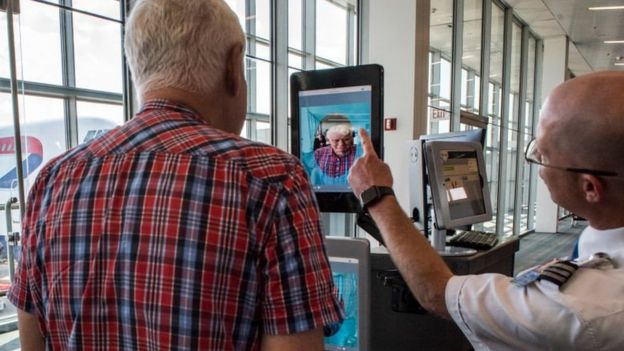 Image copyrightGETTY IMAGES
In addition, they would need to scan their passport at the departure gate for the system to be able to match the photo inside to their actual face.
The process is similar to that already used at the ePassport arrival gates at some UK airports. But it differs from Gatwick’s original test, where travellers scanned their faces at the luggage drop-off zone.
Consent concerns
That decision will limit Gatwick’s ability to use facial recognition for other services.
China’s Chengdu Shuangliu airport, for example, recently installed a system that automatically presents travellers with up-to-date information about their flights when they walk up to a screen. This is made possible because visitors have to present their passports at an earlier stage
Even so, one civil liberties group is worried travellers might not realise they can opt out.
“Our main concern… would be the issue of proper consent,” said Ioannis Kouvakas, from Privacy International.
“Placing general or vague signs that merely let individuals know that this technology is being deployed, once individuals are already inside the check-in area, is inadequate, in our view, to satisfy the strict transparency and consent requirements imposed by data-protection laws.
“If this would apply to child travellers… it raises even more concerns, considering the special protection afforded to children’s privacy and the risks associated with having their biometrics taken by the airport private entities.”
A spokeswoman for Gatwick said it had designed its use of the technology to be “compliant with all data protection law” and passengers would be able to choose to have their passports checked by human staff.
“Our next passenger trial will take place in the next six months and no data will be stored – instead it will be held momentarily while the identity check takes place, only a matter of seconds,” she said.
Children under a certain age would need parental or guardian consent, she added, although Gatwick had still to determine what the cut-off point would be.