Room: Culture News ANDROID
Culture News 5 ANDROID
Toni Morrison, who has died aged 88, was the most influential and studied American author of her generation. Born as Chloe Wofford in Ohio in 1931, she graduated in 1953 with a B.A. in English from Howard University, a historically black college located in Washington DC. She then completed an M.A. at Cornell on the work of Virginia Woolf and William Faulkner, before beginning an academic teaching career.
She married Harold Morrison, a Jamaican architect, in 1958, but after their divorce in 1964 Morrison started working as an editor for Random House in New York. It was here that she began writing fiction, publishing her first novel, The Bluest Eye, in 1970. It was her third novel published in 1977, Song of Solomon, that was her breakthrough work, winning the National Critics’ Book Circle Award.
Her most famous novel, Beloved followed in 1987. It was a fictionalised account of the 19th-century slave Margaret Garner, who killed her own daughter to save her from slavery.
Morrison became a well-known figure within the worlds of American academia, publishing and cultural life. In 1990, she gave the Massey lectures at Harvard dealing with the invisibility of the African American presence in American literature. These influential essays were later published as Playing in the Dark: Whiteness and the Literary Imagination.
The following year Morrison won the Nobel Prize for Literature. She also held a Chair in the Humanities at Princeton from 1989 until her retirement in 2006 and continued to publish important novels during the latter part of her career.
In her Massey lectures, Morrison spoke of her ambition
to draw a map, so to speak, of a critical geography and use that map to open up as much space for discovery, intellectual adventure, and close exploration as did the original charting of the New World.
Both her creative and her critical work are designed to remap the contours of American literature and culture. She aims to highlight what was omitted in the conventional forms of liberalism that governed institutional life in America during the second half of the 20th century.
Her 1993 novel Jazz, for example, involves a self-conscious revision of F. Scott Fitzgerald’s mythological “Jazz Age.” For Fitzgerald himself, this Jazz Age was centred almost exclusively around white culture. By setting her work in Harlem during the same era, Morrison executes in fictional form the remapping project that she outlined in her Harvard lectures.
‘The national amnesia’
Arguing that “the time for undiscriminating racial unity has passed,” Morrison sought, in both her fiction and non-fiction, to expose the “national amnesia” underlying often unconscious forms of racism.
Given such a remarkable career trajectory, it would seem Morrison’s literary reputation at the time of her death could hardly have been higher. Nevertheless, there is a significant gap between Morrison’s status as an Establishment figure and the radical ambiguities of her fiction. The latter, more elusive quality might well sustain her literary reputation more compellingly over time.
In Beloved, Morrison develops a conception of “rememory” (the character Sethe explains in the book this is the act of remembering a memory). Many of her fictions feature ways in which old ghosts haunt contemporary scenes.
The rhetorical reversals that are a common feature of Beloved reflect a condition where past and present, slavery and freedom, are all mixed up together. Indeed, the best of Morrison’s fiction is powerful precisely because it flirts with a pathological quality that avoids one-dimensional, political formulations.
In Tar Baby (1981), the reader is told how the black heroine’s “legs burned with the memory of tar,” despite her degree in art history from the Sorbonne. In Jazz, the heroine finds herself compelled to go back to a department store and “slap the face of a white salesgirl” who had snubbed her, despite recognising this to be self-destructive gesture.
Fatalistic cycles
Morrison, who studied classical literature at university, was influenced intellectually by the fatalistic cycles that permeate ancient Greek theatre. Something of this darker mood enters into her own fiction.
This is why Morrison’s novels are more unsettling than was her public persona. Unlike many of her intellectual contemporaries, she retained a traditional faith in aesthetic quality and the literary canon, defending fiction as offering “a more intimate version of history”.
She endorsed Barack Obama as presidential candidate in 2008 by commending his “creative imagination, which coupled with brilliance equals wisdom.”
Yet such polite terms as “creative imagination” find themselves contradicted by the cycles inherent in Morrison’s own imaginative universe. In Sula, for instance, the institution of a “National Suicide Day” epitomizes the kind of in-turned violence typical of her sombre fiction.
Morrison’s art resists classification. This quality of aesthetic elusiveness and ambiguity will make her more disconcerting representations of the psychology of power resonate with future generations of readers.
CULTURE NEWS 4 ANDROID
Dramaturgy in America was a European ideal grafted onto native aspirations. Arising in the 1970s, it became widely disseminated as a job description and set of emerging ideas in the 1980s, as a new generation of artistic directors took over regional theaters This piece attempts to indicate macrohistory by relating anecdotal microhistory, revealing snapshots of the evolution of American dramaturgy. In a series of interviews conducted over the winter and spring of 2013, Robert Blacker and I discussed the role of the dramaturg in a trio of theatrical institutions that represent three kinds of theatre organizations– regional, developmental, and classical. We talked about where the profession has been, and where it’s going, as the founding generation prepares to retire and new cultural and financial constraints produce new definitions of the role. The following is excerpted from Blacker’s remarks—Jacob Gallagher-Ross
ON THE LA JOLLA PLAYHOUSE
In only our second season La Jolla was nominated for a Tony for Best Regional Theatre. La Jolla emerged so quickly in prominence on the national scene because of the caliber of the artists that its artistic Director Des McAnuff and I were able to bring there. Artists are always the foundation of good work. I had worked as dramaturg with Des on two of his productions for Joe Papp in New York, and he invited me to join him at La Jolla as institutional Dramaturg and later Associate Artistic Director (different title, same function). We planned seasons together, and I admired his willingness to take the best idea in the room and bring in directors as good as he because he was secure in his talents. Insecurity is the death of collaboration.
We worked from personal connections, and Peter Sellars, Robert Woodruff, Bill Irwin, Stephen Sondheim, and James Lapine were a critical part of our early seasons. We also took advantage of a historical moment. A talented group of young directors who were soon to become artistic directors at theatres across the country were still available, Mark Lamos, Emily Mann, and Sellars, among them, as well as Garland Wright who withdrew from La Jolla when he got the Guthrie. Suddenly, in the 1980s, a new generation of Artistic Directors inherited the American theater from its not-for-profit founders. It was a seismic shift that moved the energy away from a handful of urban centers, where these young directors developed their ideas, to theatres across the country.
Most of these directors had worked in small theatres, and Des saw the importance of giving them the opportunity to mount productions on our Broadway-sized mainstage, often letting them choose plays and projects such as rarely produced Brecht and Sophocles that normally would not be done on this large a scale. I learned when I worked for Joe Papp that it’s as important to provide opportunities for an artist to develop their skills as focusing on the project at hand. That’s how you create an exciting theatre scene.
A larger stage often meant for these directors the opportunity to tackle large cast classics that they could not afford to do in smaller theatres. And we put together seasons in a fashion that was very important for Des McAnuff. He hated when an artistic director asked: “Do you want to do Pygmalion?” “Why would Pygmalion be the classical play out of all the classical plays I want to do,” he told me. “Ask me what I want to do.” So we worked off of lists of plays from our directors, making sure that our seasons still offered variety. Our productions were successful because they were driven by the passion that these directors brought to projects that came from their gut.
There was another reason as well. The most important artistic function of the artistic leadership of a theatre, after choosing artists and projects, is to guide productions, as they need it. Des and I were very good about helping to shape material and productions. Seeing run-throughs in the rehearsal room. Attending dress rehearsals. Continuing to give notes during previews. Des has the eye of a director and is amazing with detail. For example, he is constantly scanning the stage so he can remove anything that throws the focus. My strength was complementary – in the area of text, particularly with clarity and meaning, and using structure to achieve both. That’s what a dramaturg can do. But there is no need for rigid guidelines for any of this. Des is also the best dramaturg I know because as a playwright himself he understands a writer’s process. As collaborators, you bring your own strengths to the table and that will change with each collaboration. The ability to guide productions makes the difference between a good theatre and a great theatre and surprisingly is often lacking.
Of course, work on a new project starts before rehearsals begin with conversations and readings, and sometimes a workshop—the focus of my work for Sundance.
ON THE SUNDANCE THEATER LABS
I was invited to Sundance to restructure its annual Playwrights’ Lab, which was then a two-week plus summer event at the Sundance resort in the Utah mountains. I was Artistic Director for eight years, and each year I made a number of changes in collaboration with Philip Himberg, the Director of the Sundance Theatre Programs.
First, I proposed changing the name. Because the theatre that I found interesting was generated in multiple ways – by playwrights, by directors, sometimes through the collaboration of a group, sometimes by solo artists – I wanted to honor every way that theatre work is generated. And I wanted to bring in projects that ran the full range of American theatre from the avant-garde to traditional musicals. So I suggested changing the name to the Sundance Theater Lab. Playwrights were understandably concerned that their access to the Lab was more limited and protested. More on that later.
Another change I implemented for our first season was based on my experience attending the annual O’Neill Playwrights Conference. The admirable success of their workshops turned the Conference into a marketplace for artistic directors and others to shop for a product. I was concerned that the pressure to be at your best when an important producer attended a presentation of your play would curtail the freedom of artists to explore and experiment. And so the Sundance Theater Lab became a private affair. The artists loved it. The only audiences for presentations at the end was the community of artists and staff who were working there. With one exception. If you were already committed to producing a project at the Lab, you needed to see it in its latest state to help move it forward thereafter. Those visitors, however, were only allowed to see their project.
Feedback sessions in front of an audience, the surest way to shut down a writer, also became private and limited to a handful of participants. We tried not to hold them immediately after a presentation when artists were still digesting what they had seen. I began them by asking what the creators learned from watching their work and then continued by requesting questions that they wanted us to answer. We moved on to our own questions and comments thereafter.
If I felt a young project was not ready for a presentation and the writer agreed, we did not do one. If a writer was timid about presenting something I thought would benefit from the presence of an audience, I would ask artists to consider doing so. The secret to the success of any workshop where the projects are at different stages of development is to give them the individual treatment that they need and deserve.
Changes continued through seven out of my eight years there and were based on our observations, and feedback from the artists. One of the most important was implemented for our second year. Rehearsing every day, writers had little time to rewrite, sometimes putting in all-nighters to turn in rewrites based on what they had seen the day before. This seemed unproductive to me, and so for our second season we lengthened the Lab to three full weeks and cut down rehearsals to every other day so that the writers would have a full day in between to write – and to think. One of the most important things that any artist needs is think-time. At Sundance, they could take a long walk on the incredible mountain that towers over the resort. In that solitude, an important may idea come to you. Well, the artists agreed, and the Sundance Institute was extraordinarily generous in giving us more money to expand the length of our residency there.
I brought in dramaturgs on two levels: those who worked on a pair of projects and work and would be present at those rehearsals. In addition, I brought in two mentors, who helped me visit rehearsals, occasionally giving feedback, but also to help Philip and me track how projects were doing. This also gave them the opportunity to get to know artists and projects before they became part of the feedback sessions at the end. For mentors, I often chose artistic directors I knew who were good at giving notes. For the first season, I invited Des McAnuff and Emily Mann. Later I included playwrights who were also teachers, such as Marsha Norman.
The people who attended the final critique sessions were the writer, director, and dramaturg who were working on the project, the two mentors, the dramaturgs who were working on other projects, in addition to me and Philip. I made it clear that it was perfectly fine to make limited observations. I think it’s a trap to think that you always must have something to say. Not everyone understands or is sympathetic to every project. Sometimes the best thing you can offer is keeping your mouth shut. I would lead the sessions and we’d try to keep them, as much as possible, as a dialogue. This kind of session is always very sensitive, and when a writer showed signs of fatigue, I would bring it to an end if I had not already done so. The stage the project was at was also an important consideration. If you try to get a writer to celebrate about a project that is in the earliest stages, they may articulate something which should not yet be verbalized. Once you verbalize something, you’re beginning to freeze what the piece is.
After three seasons, we expanded the Sundance theater programs. We created a writing retreat for playwrights, in part to help address the criticism that the Theatre Lab had cut down on opportunities for writers. (On average, six of our eight projects at the Lab still had a playwright at the center.) Philip found an arts colony on a cattle ranch in Wyoming – in February – run by the amazing Ucross Foundation. Only we theatre folk were crazy enough to go to Wyoming in the winter. We usually brought seven playwrights and a composer there each year.
I learned the value of the austere beauty of the Wyoming plateau and the lab in the majestic Utah mountains for our urban bound art. We usually make theatre in cities, but these rural retreats offered the opportunity to reflect on the immensity of the world and to ponder something outside of yourself. And that informed the breadth and depth of the work. The format at Ucross was simple. You were there to write. You didn’t need to show anyone what you were working on, but ad hoc private conversations took place. Solitude until dinner. (Lunches were even brought to our workrooms.) Conversation and community over the dinner table. There were always two events at the Lab and the Retreat, the project you were working on and community among the artists who were there. Conversations about the art; practical exchanges about the commerce. Friendships formed, lasting and fleeting. Watching the artists gathered at these events it began to feel as if there really was an American theatre in this vast country where we seldom meet. It was ironic that this occurred at a ski resort and a cattle ranch thanks to the visionaries who brought our visionaries there.
ON THE STRATFORD SHAKESPEARE FESTIVAL OF CANADA
Going to Stratford was intimidating because its amazing acting company included actors who had been there for 20 to 30 years, and whose knowledge about Shakespeare made my eighteen productions seem a flirtation. It was a great opportunity to learn more about my favorite writer. In my early career, Joe Papp showed me the importance of changing your focus regularly, so you don’t go stale. Having worked in New York, regional and developmental theatre, the classics were next.
Stratford’s first two artistic directors, Tyrone Guthrie, and Michael Langham, were pioneers, strong directors with new ideas. But as the Festival had evolved over the decades, it had become better-known as an actor’s theater. Des restored the balance between director and actor and sought to put the playwright back at the center of the work. With Shakespeare, we encouraged everyone to dig into the texts and find what is really there. Very often what we see in productions of Shakespeare are sentimental notions that come from false traditions which have evolved over the centuries. Tradition in theatre, Des would say, is often the last five productions you’ve seen of a play. And what we most often see are productions that are overcut and so have diminished the magnificence of the wide canvas that Shakespeare is presenting. I was shocked to see that in the seven productions of Henry V produced at Stratford in its first 50 years, all but two had cut the most onerous action Henry takes in the play. At the battle of Agincourt, when he is badly outnumbered by the French, he orders the execution of his prisoners so he can use the soldiers guarding them on the battlefield. How can a King who is the presumed model of a good leader do this? Well, Shakespeare is more complex than usually presented. In Henry V he actually makes an implicit comparison between Henry and Machiavelli by paraphrasing one of The Prince’s most famous lines. My job as an institutional Dramaturg was to fight for the complexity in Shakespeare’s writing and promote the excavation of the text. Scenes that seem irrelevant are often clues to what issues were circling in his head. I knew from my work with living playwrights that they are always reflecting their times, and so we looked to the history of Shakespeare’s time for other clues. The Guy Fawkes Gunpowder Plot to blow up the King and Parliament is key to understanding Macbeth.
Des also brought more living playwrights to Stratford. He believes it’s important to do classical work and new work side by side because they inform each other. You don’t have to reinvent the wheel, he would tell you. If you’re having a problem as a writer, perhaps you can find a solution in a classic play. And by doing new work alongside the classics, you are reminded that classics are not museum pieces. He expanded the number of playwriting commissions and I created a playwriting retreat based on the one I had instituted at Sundance. Canadian playwrights got to know us, and we got to know them. There were spirited discussions over dinner, and I learned so much about the mechanisms of contemporary Canadian theater and how Stratford could perhaps help some of the problems they encountered. An institutional dramaturg must always have his/her eye on the big picture, as well as the project at hand. That is how you move our art form forward.
On The State of American Dramaturgy
I began working as a dramaturg at the Public Theater in the 1970s and seen many changes in the decades that I’ve been working in the theater. When I began there were only a handful of dramaturgs. As university programs have expanded, I wonder how we are going to employ all the graduates that come out of them. I’ve seen the impact that dramaturgy has had on the profession. I see the talent, but I also see a lack of opportunity in these difficult economic times. Opportunity and money are always related. And so I feel my job in my later years is to hang in there long enough to help ignite the next great age of theater. Theater is always a marathon race and we’re constantly passing the baton. That’s why I am hanging in here: to pass the baton.
This post was written by the author in their personal capacity.The opinions expressed in this article are the author’s own and do not reflect the view of The Theatre Times, their staff or collaborators.
Culture News 3 ANDROID
“There are bombardments constantly on the outskirts of Donetsk, while in central Donetsk they stage beauty pageants and literary parties, and the cafes work all night.” – Yehor Makiyivka, 2019
2019 marks the fifth year of the ongoing conflict in Eastern Ukraine. What began as a number of street protests against former President Yanukovych’s suspension of an EU-Ukraine agreement in 2013 soon became a fully blown war between Russian separatists the Ukrainian military: the Euromaidan protests and their bloody suppression; the sudden annexation of the Crimean peninsula; the subsequent declaration of independence of the Donetsk and Luhansk regions; the tragedy of Malaysia Airlines Flight MH17; the negotiations of several ceasefires and unsuccessful Minsk peace deals. Most of us will remember having heard about these events in recent years. But as time went by, the war, its over 10,000 civilian casualties and more than 1.5 million displaced people, have lost their newsworthiness. To break this silence means to stand up and speak for those unable to do so, trapped somewhere along the 280-miles-long frontline.
After the Vaults Festival’s showcase of Counting Sheep – Staging a Revolution earlier this year, the Cockpit Theatre hosted the world premiere of a new performance that puts the forgotten war into the spotlight. Interbeing – Stories from a Current War is an explosion of diverse performance styles from acrobatics to mime, dance and object animation. It creates a colorful canvas to the beats of an original score to express the multilayered battles that individuals fight when forced to adapt to drastic change.
The international ensemble around Ukrainian-Swedish Artistic Director Lana Biba presents a story of life, love, and loss based on the lived experience of soldiers, residents, and artists, pulled together over a period of almost two years. Archive photographs from the Donbas region serve as the visual frame. Together with real-life interviews, they build the foundation for the partly autobiographical script.
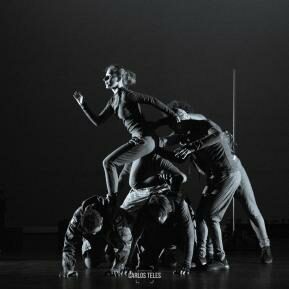
The audience follows the story of a handful of characters and watches them transform in the whirls of conflict. We’re introduced to a young man who spends his time spraying graffiti on city walls, a cheerful primary school English teacher and a photographer, carefully scouting the city for the perfect motif. They’re three people that go about their ordinary lives. But then everything changes. Military tanks appear; people assemble in the squares; the young graffiti artist is recruited into the army. Yet, some things stay the same: the teacher still goes to work in the morning and the children still come to school – until there’s a loud noise one morning. A missile hits the school. No more children. Now, everything has truly changed.
Having left the city with a group of people, the graffiti-kid-turned-soldier, the teacher and the photographer, now working for the press, find themselves somewhere in the woods. Scenes alternate between calm evenings pf storytelling stories, sudden skirmish, fallbacks, and parties around the fire. We observe how individuals are forced to adapt to their new surroundings. In a world where death is omnipresent, the teacher swaps the crayon for a machine-gun. People who didn’t know each other before are ready to die for each other and the cause they all stand for. The photographer steps onto a mine. There’s a clear and loud clicking noise, then the shock in his face. The graffiti kid swaps places with him. All he asks for is the last photograph with his gun.
We don’t know how long the group’s been fighting, how many people they lost and how they got back home. Once back in the city, the photographer’s celebrated for his work documenting life in armed conflict. The teacher’s back in school; the two of them are a couple and live together now. Their lives appear normal, they even have a dog. But behind the facades of work and a rich social life both have to bear the trauma of war. At times, their joint experience eases their suffering, but the journey of recovery from PTSD is different for each of them. They long for each other’s embrace but are unable to fill the void within themselves. The photographer has trouble to accept that people around him continue with their lives as if nothing had happened. They socialize and tell jokes, have parties, children – and are happy. All the while, he’s eaten up by guilt. Why did he survive? The protagonists have taken the fight off the battlefield into their home, against each other and within themselves. It’s a war they can’t win.
Interbeing highlights that throughout this continuous war, everything is connected. It underlines the absurdity of war, where love/hate, sadness/happiness, disbelief/hope all co-exist. As one of the people interviewed for the show states, “we never cried so much as during the war, but we never laughed that much either.”
Culture News2 ANDROID
Approach with care the book that offers up a tale of Ireland in the old days. Since Patrick Kavanagh published The Great Hunger in 1942, any book about the poetry of rural life and youth’s endless summer must of necessity be acknowledged as sentimental. The best rural writers demolished these cliches long ago, and built in their place a literature that chronicled with unflinching, sorrowful honesty the world we all came from before we moved into the cities.
 One thinks of John McGahern, or RS Thomas’s dismissal of those who idealised Wales: “Too far for you to see / The fluke and the foot-rot and the fat maggot”. Without great skill, the country chronicler’s work will fall into the category of tourist fodder – Scottish shortbread, English ale, Welsh rarebit and tales of green Ireland. Such books only kill the places they claim to love.
It takes time for Niall Williams to convince you that tourist fodder isn’t what he’s producing in This Is Happiness, the successor to his Booker-longlisted 2014 novel History of the Rain. The question Williams’s narrator, Noe (short for Noel), asks himself, “What does it matter what one old man was hoping one time?”, lingers with you as you read. Noe goes to stay with his grandparents in the village of Faha in Kerry at the same time as it is being connected up to the national grid, some time in the early 1970s. Throughout the spring that passes into summer in the course of his story, it also stops raining in this normally sodden parish. In the wake of personal grief, Noe has experienced a crisis of faith, and is taking time away from the seminary where he is studying for the priesthood. He ends up sharing a room with a man named Christy, who is laying cables into the village; Noe’s grandparents had agreed to take him in as a lodger before they knew Noe was coming to stay.
Bringing electricity turns out only to be Christy’s means of coming to Faha, though; his real reason for doing so is a woman named Annie Mooney, whom the locals know as Mrs Gaffney the chemist’s widow. Half a century after he last saw her, Christy woke up one day in a boarding house in Boston and decided that he needed to see her again. All a little baroque, but Noe acknowledges that people in Faha prefer complexity over plain speaking, which has been corrupted by the politicians. So let’s forgive him that.
But the plot is really a vehicle for Noe, half a century after the events he recalls, to write down his memories of Faha. The real heart of the book is a man remembering a summer when grief gave way to romantic love: the beginning of his adult life. This is how the novel finally earns its setting and sentimentality – it is among these familiar tropes of Irish writing that Noe’s youth happened, so it is here he must inevitably return in old age, “because, at the end, we all go back to the beginning”.
As his story develops into one of boyish, sexless infatuation, what becomes clear is that the book is sentimental because the love it recalls – the romantic, abstracted love of a young man – is deeply sentimental, and Williams is being faithful to his subject. The first time Noe is struck by the thunderbolt, what he records is that “she is gentle, all simplicity and kindness … she is small and light and all business … her eyebrows … have an attraction which can’t be measured”, which is the most chaste rendering of love at first sight I think I’ve ever read, but by no means an unfamiliar kind of bloodless, youthful longing.
The pleasure of this novel lies in its eye for detail. The plot, having been established, then takes a long time to do not very much more. What happens instead is a kind of tectonic movement from spring into summer, marked by the rhythms of village life. Williams is excellent on churchgoing, amateur dramatics, parking, the cinema. He lavishes close attention on his parishioners, and finds rich material there. He has a humorist’s eye, and his own fond amusement at the people he writes about shines out through the writing.
The fields of Ireland are very crowded, but by the conclusion of This Is Happiness, you feel Williams has justified adding another book to the herd.
Culture News 2 ANDROID
Miso, a fermented soy and rice paste, is found everywhere in Japanese cuisine. It is one of the most important ingredients in Japanese cooking- a delicate seasoning which brings out the best in many dishes. It is found as an accompaniment to almost every meal and is said to aid digestion.
Japan has more than a thousand miso producers. The Nagano mountains in the centre of the country are one of the regions famous for producing the soybean paste.
Kosuke Ishii comes from a long line of miso producers. His ancestors founded the Ishii Company in the nineteenth century. Since then, miso has been fermented at his company in cypress casks – a process which can take from one to three years.
The recipe is unchanged: rice, salt, soy, and patience. The powerfully aromatic dough is worked by hand following a centuries-old custom.
“Today, most producers favour quantity and speed,” explains Kosuke Ishii. “Our mission is to keep the traditional know-how, preserve the taste, the colour and the smell of the miso in the long-term, to transmit to future generations.”
The Nagano prefecture produces nearly half of all Japanese miso. And there are hundreds of varieties.
Sano Miso is said to be the biggest and best miso store in Tokyo. People come from miles around to find their favourite ingredient. The soy bean paste is used in soup, but also as a condiment.
Noriko Sano is a Miso ‘sommelier’. She says miso is a part of everyday life for people in Japan.
“For more than 700 years, the Japanese have been drinking miso soup every day,” she says. “For the Japanese, miso is also food for the soul.”
But why does this ingredient come in so many different colours?
“Japan is a rather long country. In general, miso is darker in the north and lighter in the south,” says Noriko Sano. “When the climate is cold, the miso is browner and more salty. While in the south, it is more white and softer.”
In Japan, there is a saying: “There is no set time for miso. It’s always time to eat.” And it’s true, miso is the basis of a typical Japanese meal.
“A bowl of rice, miso soup, and some condiments, like these pickled vegetables – called tsukemono. It’s really the basic meal,” concludes Noriko Sano.
Culture News1 ANDROID
One of Europe’s leading contemporary art events, the Lyon Biennale, moves into uncharted territory for its 15th edition – the former Fagor-Brandt factory, which closed in 2015.
The team at the prestigious Palais de Tokyo in Paris were this year’s guest curators, attracted by the immense possibilities of the 29,000 square-metre venue.
Vittoria Matarrese, curator at the Palais de Tokyo, told Cult : “We really wanted to create the experience of crossing a landscape. So we began to imagine a landscape – not just a natural landscape but a landscape that was also economic, social, historical, political, bacteriological, going from the miniscule to a more cosmogonic scale.”
Modernist design, glam rock and humour come together in ‘Design Room’ a multilevel, multimedia installation by Jakob Lena Knebl and Ashley Hans Scheirl.
“I like to use the formula trans-media, trans-genre, transgender, because I am also transgender, and in my paintings I try to always mix the different genres and media,” Scheirl says.
The duo also explore the dark side of gentrification and our value system, with Knebl putting the case for “a completely new order of society in future”.
Another installation, Prometheus Delivered, brings science and art together.
It’s a marble sculpture portraying the bound Prometheus being slowly devoured by stone-eating bacteria.
Artist Thomas Feuerstein explains how the rest of the myth plays out in his installation.
“The punishment was every day an eagle comes and eats the liver of Prometheus and the liver was the symbol for the future. I wanted the scientists of the medical university in Austria to produce, to create a new liver for my Prometheus and they succeeded and did a special 3D sculpture grown from human liver cells.”
As well as the giant former Fagor-Brandt factory, the Biennale takes place all over Lyon, in the city centre and in the Museum of Contemporary Art.
French artist Karim Kal exhibits a series of photographs from a young offenders’ institution in Meyzieu, on the outskirts of Lyon.
The images are stark but document tiny details of prison life.
“The idea is to adopt the point of view of the prisoner,” Kal says. “Here we have a portrait of one of the guards done by one of the prisoners in biro and also you have the glass that is broken because of the practice that is widespread in prison environments of slamming their windows to show their discontent.”
Adding to the starkness, the photographs were taken at night, with a powerful flash and a fast shutter speed which made the background absoutely black.
Works from more than 50 artists from around the globe are on show – most of them world premieres.